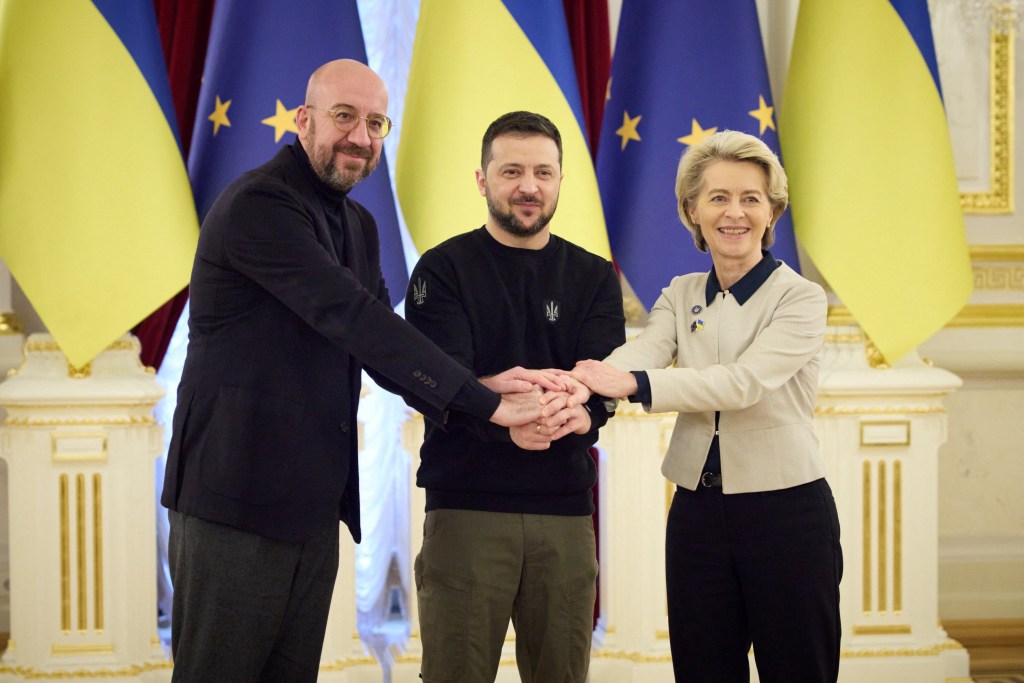
Over four years after Ukraine first applied for membership to the European Union (EU) in 2022, the Euro-Slavic country has officially taken another major step towards EU accession.
Entry into the EU is based on a number of things, but the main one that’s been standing in Ukraine’s way has been the unanimous vote from all current EU members required to approve new members. Until recently, that unanimous vote was being blocked by former Hungarian Prime Minister Victor Orban, an ally of Russian President Vladimir Putin who is currently leading a war against Ukraine. After Orban was replaced by Peter Magyar in the April 2026 Hungarian elections, that single vote blockade was removed. On Monday June 15, 2026, Ukraine was approved to move forward in the application process.
Although the recent vote has opened the path toward accession, Ukraine still has a multi-year process to go through before it can become an official member.
As part of membership negotiations, the EU requires all prospective countries to implement certain reforms to meet certain conditions. Depending on the country and the circumstances around their joining the EU, this can involve constitutional, judicial, anti-corruption, and media legislation reforms, among many others.
According to a European Commission report published in November 2025, Ukraine had “adopted roadmaps on rule of law, public administration reform and on the functioning of democratic institutions, as well as an action plan on national minorities.”
The next step in negotiations involves what the EU is calling six “clusters” to highlight areas for Ukraine to continue improving on as talks continue.
“[The Commission] will present the E.U.’s list of conditions to be fulfilled, and on the other side, Ukraine will tell the E.U. what they plan to do, and how they plan to meet these conditions,” said Frank Schimmelfennig, a professor of European politics at ETH Zurich whose research focuses on European integration. “From time-to-time they will come together again, and check where things stand.”
The six clusters cover areas such as democracy, rule of law, governance, judicial reform, agriculture, sustainability, trade and economic policy.
Ukrainian officials have said they are hoping to fast track the process and aim for accession sometime in 2027, although other EU leaders have questioned that timeline. On average, it takes a country nine years to join the EU. The shortest process was three years for Finland and the longest was 14 years for Cyprus. Hungary also still poses a problem to Ukraine’s fast track hopes; even under new leadership, the government has made it clear they will oppose any efforts to fast track Ukraine’s application.
According to EU officials, 2030 seems to be the “magic date” for Ukrainian membership, but there is no official timeline for what is guaranteed to be a long and difficult road.

