This is a long article. Would you like to see an AI-generated summary?
What was the last prompt you typed into ChatGPT? Maybe you asked it to summarize an article you didn’t have time to read. Or maybe you asked it to help you write a work email. Maybe you were just messing around with its image generation feature trying to create a funny picture of you riding a unicorn or going skydiving. Maybe you didn’t use ChatGPT but one of the other AI Chatbots like Grok, CoPilot, or Gemini.
You probably didn’t think twice about using it, especially if, like thousands of others, AI chatbots have become a tool in your daily life. There’s no argument that they aren’t helpful; for working adults with a lot on their plates, giving the small taste like writing emails or summarizing reports may seem like a no brainer so you can have more time to focus on the important tasks like managing employees, running a business, leading meetings, etc.
For adults who grew up in an AI-free world and have the intelligence to use it as a beneficial tool to make their lives easier, AI chatbots may feel like just another skill to keep under your belt. However, for students and kids who have never known a world without AI, this new, fascinating and easy to use development has become more than a tool – it has become a new way of thinking.
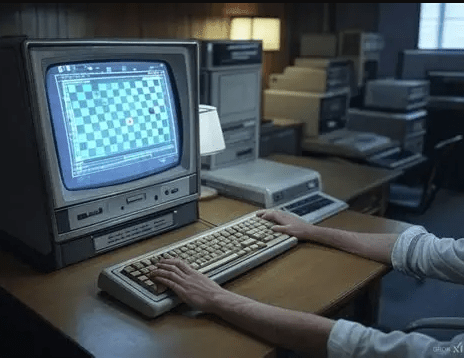
Artificial Intelligence (AI) isn’t a new invention. Its roots go all the way back to the 1930s with the work of British mathematician Alan Turing and his study of memory storage in computational machines. The first successful AI program was written in 1951 by Christopher Strachey when he created a digital opponent for a game of checkers.
Over the past century, scientists, mathematicians, and coding experts have continued to advance artificial intelligence to the level we see it at today.
Artificial intelligence refers to any time a computer learns or makes a decision independent from human intervention. The form of AI that has recently skyrocketed in popularity falls into the category of generative AI. Generative AI, as defined by the Merriam-Webster Dictionary, is “artificial intelligence that is capable of generating new content in response to a submitted prompt by learning from a large reference database of examples.”
Like all other tools, Generative AI isn’t inherently good or bad – it’s the way it’s used that makes the difference.
Different age groups and generations have shown different levels of dependence and comfort using generative AI. With the boom in generative AI research and study being so new – generative AI didn’t even exist as more than a concept until the early-mid 2010s – studies on the pros and cons of using generative AI on a consistent basis are much fewer than those on other forms of AI. One of the main concerns about generative AI over the past couple years has been about the effect consistent use of chatbots like ChatGPT, Gemini, CoPilot and more will have on the mental, social, and emotional skills and wellbeing of children who have grown up never knowing life without it.
While many adults have quickly gone the route of attempting to ban the use of generative AI from schools and universities to keep learning looking like it has since the 80s, some recent studies have shown that the solution may lean less towards completely banning any hint of AI from classrooms and more towards teaching students how to properly use it as one of the tools in their education.
“Generative AI is here and already having an impact,” said Stephen J. Aguilar, associate professor at the USC Rossier School of Education. “What matters now is whether we use it to deepen learning or to avoid it.”
In a national study, researchers surveyed 1,000 U.S. college students and found that most uses of generative AI fall into one of two categories: “executive help”, used when looking for a fast solution or answer with little to no explanation or effort, and “instrumental help”, used to help explain concepts in-depth and support independent learning. The study found that students who were overwhelmed or struggling in class tended toward executive help, while students who were receiving proper support and encouragement from their teachers tended toward instrumental help.
A different study by the Center for Democracy and Technology showed benefits for teachers as well as students. A 2025 report showed that, of the teachers and educators interviewed, 69% use AI tools to improve their teaching methods and skills, 59% said AI has enabled more personalized learning, and 55% said AI has given them more time to interact directly with their students.
At this point, you may be wondering what the big issue with AI in schools is. If it’s been shown to be beneficial to teachers and students, why are parents and school systems across the country fighting so hard to restrict or ban it? The answer is actually pretty simple: a lack of education from all sides.
While AI might have beneficial uses for students, it also offers easy solutions to learning. Students can enter prompts into the chatbot and the program will instantly spit out an answer that meets all the criteria without the student doing any work or thinking. Instead of reading 50 mind-numbing pages of a textbook, students can copy and paste it into a chatbot and get a summary that takes five minutes to glance through.
In the 2025 CDT study, 71% of teachers said AI has created an additional struggle when grading students’ work because they now have to spend time making sure it’s actually the student’s work and not AI.
Homework isn’t the only concern when it comes to students using AI.
“Our research shows AI use in schools comes with real risks, like large-scale data breaches, tech-fueled sexual harassment and bullying, and treating students unfairly,” said Elizabeth Laird, director of the equity in civic technology project at the Center for Democracy and Technology. “Acknowledging those risks enables education leaders, policymakers, and communities to mount prevention and response efforts so that the positive uses of AI are not overshadowed by harm to students.”
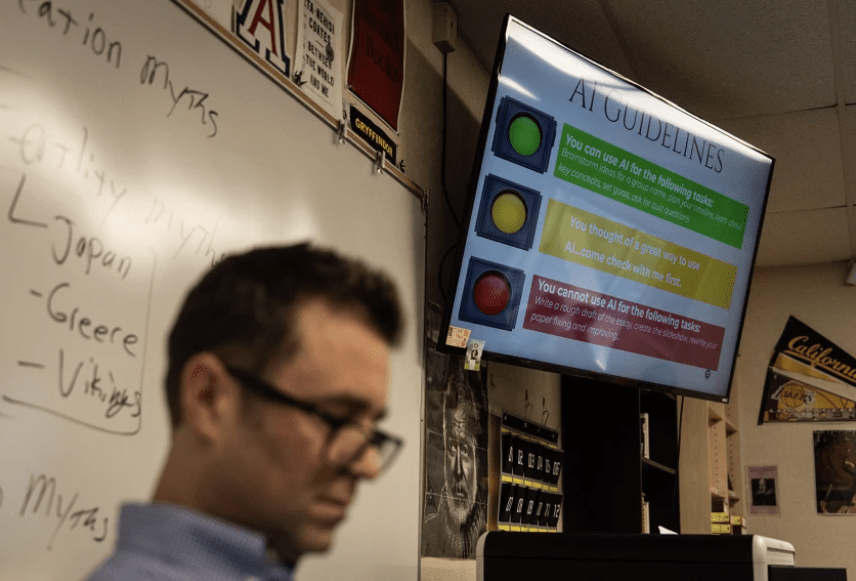
Of the studies that have been done in the time since generative AI became a household tool, a common conclusion being drawn is that generative AI can be beneficial for both students and teachers when used in the right way.
However, learning how to use it in the right way requires training. Like with any new technology, no one will instantly know how to use generative AI. There is a learning curve that must take place before it can be used to our greatest advantage. By banning AI in schools, you’re not making it so students will stop using AI – you’re just ensuring they’ll keep using it wrong.
“AI can… hinder learning when students are overcommitted, overworked, and see AI exclusively as a time-saving device,” says Professor Dan Levy, Senior Lecturer in Public Policy at the Harvard Kennedy School and the co-author of “Teaching Effectively with ChatGPT”. “But if AI can save you time doing the grunt work so you can devote that time to do more serious learning, I think that is a plus. There are reasons to be optimistic and there are reasons to be worried about AI, but AI is here to stay, so it’s not like we can say, “OK, forget about AI.” We’d better figure out ways of collaborating with it and leveraging it in ways that advance our goals as educators, learners, and humans.”
Levy isn’t alone in that opinion.
“What schools need to do is help teachers and students use [AI tools] in the right and best ways,” said Joseph South, the chief innovation officer for ISTE + ASCD. “If we do that, I believe, over time, we’ll be able to increase the value and decrease the risk.”
The only way that the use of generative AI in educational settings will benefit students and educators is if it becomes part of the solution, instead of being the entire solution. Its use would be similar to the way a calculator is used in math classes; while a calculator can solve an equation in an instant, it’s useless if the student doesn’t know what equation to use to solve the problem in the first place.
Generative AI can help students edit their papers, use it for personal tutoring, brainstorm ideas for a project, and much, much more. If its user has the right knowledge, it can become another tool for success and assist in time management and prioritization, in the same way many adults use it at work.
However, none of that can happen until people learn to accept that it’s here, not going anywhere, and that it’s better to guide students now on the proper way to use it than ignore it and let students form bad habits and become dependent on a tool that does nothing more than spit out answers that may or may not be what they need.
Disclaimer: this article specifically focuses on the issues concerning AI and schools. Generative AI has many other issues including extreme damage to the earth, excessive consumption of drinkable water, pollution to the air and water from data centers, piracy of artist’s and writer’s work from online, and much more. This article is not an encouragement for the increased use of artificial intelligence in schools or work. However, as stated in the article, generative AI is here and, unfortunately, not going away any time soon. This article was inspired by studies showing the damage improper use of generative AI has on students, especially concerning their mental, emotional, and social health. This article is strictly meant to be a suggestion on how to protect young children from the consequences of poor use of artificial intelligence before it can grow into a multi-generation issue.

