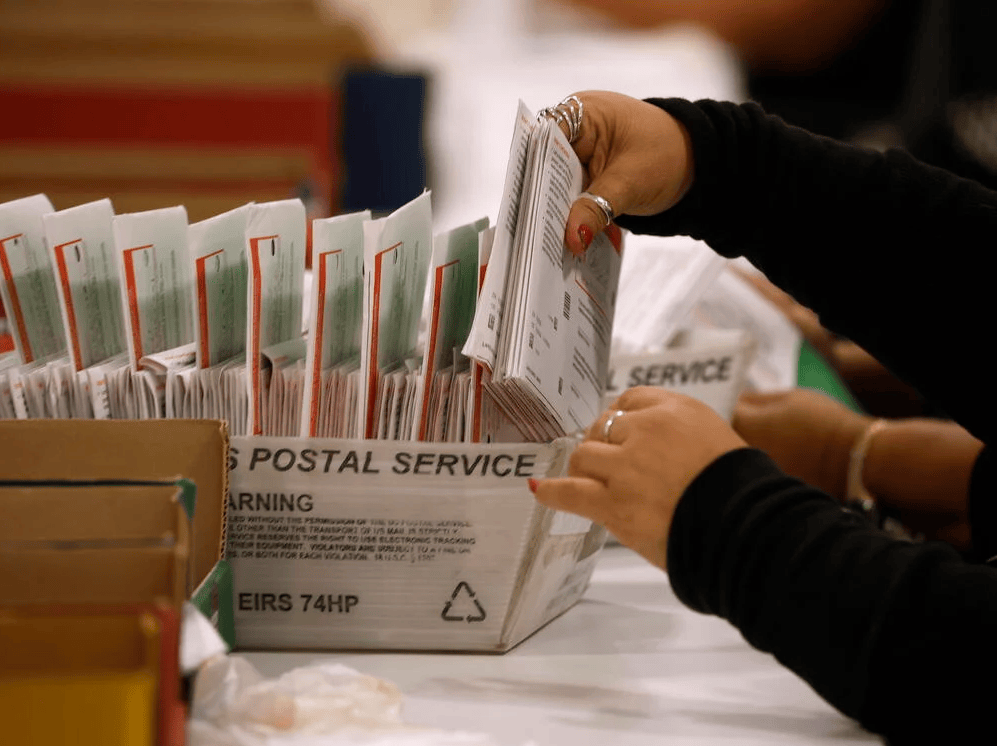
After a federal judge blocked President Donald Trump’s appeal to place restrictions on mail-in ballots Sept. 4, the Trump Administration sent another appeal to the Supreme Court in an effort to overturn the decision.
Judge Indira Talwani ruled implementation of restricted mail-in ballot laws so close to the November midterm elections “threatens disenfranchisement of millions of United States Citizens who seek to vote by mail.”
Talwani’s ruling will hold through the upcoming November elections unless overturned by a higher court.
The Trump Administration filed an urgent appeal with the Supreme Court Sept. 6 requesting approval for the plan in a reversal of Talwani’s ruling. The administration also requested the 1st U.S. Circuit Court of Appeals review Talwani’s ruling with the possibility of having the ruling overturned without a new ruling to replace it.
The Court of Appeals isn’t expected to return a ruling before 5 p.m. ET Sept. 8, and the Supreme Court isn’t expected to return a ruling before 4 p.m. ET Sept. 9.
If approved, Trump’s plan would change two major parts of mail-in voting.
First, it would require the Department of Homeland Security to put together state-wide citizenship lists based on federal records, Social Security and immigration records. This would allow states to automatically know who is eligible to vote and request a mail-in ballot.
Second, state election officials would be required to upload the names and addresses of every mail-ballot recipient to a USPS database before the ballots can be sent to voters. Voters who send in mail-in ballots but aren’t listed in the database will have their vote rejected.
The Trump Administration says they plan to use this new mail-balloting system to monitor for unlawful votes; Trump continues to claim his loss in the 2020 Presidential Election was due to mail-in voter fraud.
Voting rights groups, Democratic Party leaders and some Republicans have voiced opposition due to both short-term and long-term effects of the plan.
The main short-term issue with attempting to implement the new mail-ballot system before the November election is that some states have already begun to send mail-ballots to voters.
“Ballots have already begun to be mailed in North Carolina, and more States will begin the mailing process as the injunction remains in place — including Alabama on September 9 and at least five States the week of September 13,” Solicitor General John Sauer said. “Once those ballot envelopes enter the mailstream, there is no retrieving them. And while the injunction allows the Postal Service and the States to continue taking steps to ensure that their envelopes satisfy the Rule’s requirements … each day the injunction is in place risks sowing confusion and chaos because the injunction makes those preparatory steps voluntary, rather than mandatory.”
USPS have said they will not begin using the new system for the upcoming November midterms unless federally mandated.
Long-term issues include concerns over who will have access to the names being submitted to the USPS database. A federal whistleblower with direct knowledge of the mail ballot plan spoke out against it, calling the plan ‘secretive, rushed, chaotic, and fundamentally flawed process.”
“The Whistleblower also raises grave concerns that the administration has hidden the high likelihood that the new ballot mail verification processes will result in major disruptions in mail ballots ever getting delivered to voters,” according to a report prepared by the group Whistleblower Aid.
The upcoming November midterm elections are especially important to the Trump Administration because they could change which party controls Congress. At the moment, both sections of Congress are controlled by Republicans, with the Senate learning 53-45 and the House of Representatives leaning 218-212. If the Democratic party takes control of one or both sections of Congress, they could cause major issues for the Trump Administration’s plans over the next two years.

