
For soon-to-be high school graduates, the thought of what comes after you cross the stage and get your diploma might be daunting. Choices like community college vs. a 4-year university, near or far from home, cost, major/field of study, taking a year off or diving straight back into school, and more may feel overwhelming in the moment. And while there are many things to look at when planning for your future, the two most important things to keep in mind are:
- There is no “right” path. What your friends do might look vastly different from you, and that’s perfectly fine. The most important thing is that you find the path that works for you.
- Know which decisions are permanent, and which aren’t – likely you’ll realize you have a lot more room to make mistakes and try again than it initially feels like. Things like changing your major or transferring to a different university aren’t as big of a deal as they may seem. College becomes a lot less stressful when you think of it as a time and place to explore the options for your future instead of something to just survive and get over with (though there will be days it feels like that too).
In this article, we’ll break down a few of the different ways community colleges, 4-year universities, and trade schools can each set you up for different forms of success.
Price of Tuition
Often, the cost of tuition is what makes the final decision when it comes to a post-high school path. If finances are your biggest concern or consideration, you probably aren’t looking at jumping straight into a 4-year university. Unless you’re going to a public university under in-state tuition, a full degree at a private or out-of-state school will likely cost you upwards of $180,000 without scholarships, financial aid, or grants.
On the other hand, community college costs on average $12,000 per year of study for full-time students. Even spending just one year at a community college could end up saving you $38,000 or more while still allowing you to take classes toward your degree and finish your general education credits.
If a traditional degree isn’t for you, trade school might be another option to look at. Trade schools typically focus on hands-on training for skilled careers such as HVAC, welding, or technology. They can also train students for some healthcare careers or culinary or cosmetology certificates.
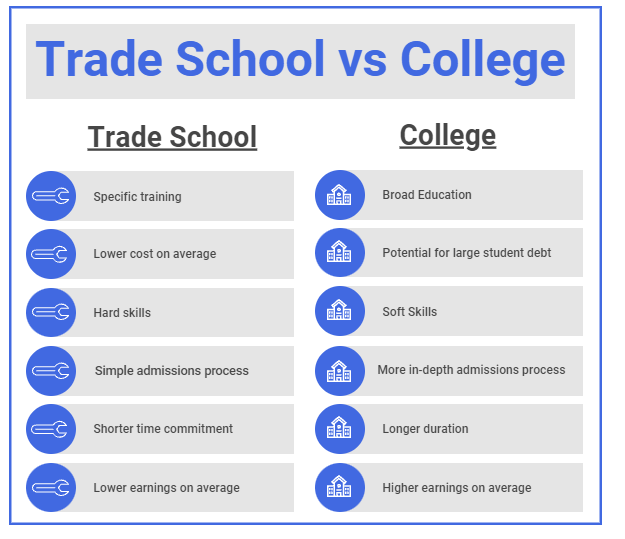
Trade schools are probably the cheapest option on this list, with certificates typically costing somewhere between $5,000-$30,000. With a trade school, you’re much more likely to graduate with little to no debt compared to traditional college students. Also, most trade school programs only take two years to complete, meaning students can join the workforce faster and start working a full-time job.
Before you go running to join a trade school (and your parents start hunting me down with pitchforks), there are some negative sides to getting a degree from a trade school. While it may sound great to start earning a full-time wage two-three years before the rest of your friends, most trade jobs don’t have much room for salary raises or promotions without additional education. Also, many trade jobs are physical work, meaning injuries or illness could leave you without a job and no way to make money. In addition, many trade jobs experience slow and busy seasons, meaning rent will likely be easier to make some months than others.

Admission Requirements
As someone who has filled out applications for both community college and 4-year universities, there is definitely a difference between the length, rigor, amount of information required, and price of the two different applications.
Community college applications tend to be easier to fill out and submit than university applications, usually only requiring a high school transcript and some personal information to get you enrolled.
University applications, on the other hand, can ask for a range of things including:
- ACT/SAT scores
- High school transcripts and GPA
- Recommendation Letters
- Essays
- An application submission fee
- Resume or list of high school extracurriculars
Certain degrees or schools within the universities may also have separate portfolio or audition fees, submissions, and forms on top of the overall school application.
Something for transfer students to keep in mind is that requesting your transcript to be sent to the schools you’re applying to also costs money per school and can take days to weeks to go through, so don’t save this until the last second.
Trade school application requirements run closer to community college applications in what is needed. Most require proof of a high school diploma, GED, or equivalent level of education, some personal information, and sometimes a placement test. Specific trades may have more requirements, but the forms are typically much easier to fill out and submit than those for a 4-year university.
Degree Types and Career Opportunities
This section is where you’re going to see probably the biggest difference between the three kinds of schools.
Out of the three, 4-year universities are the most diverse in the kind of degree you can earn. 4-year university students graduate typically with some form of a Bachelor’s degree, the most common being a Bachelor of Science (B.S.), Bachelor of Arts (B.A.) or a Bachelor of Fine Arts (B.F.A.). Students can also graduate with a minor or certificate in a separate or parallel field, double major and earn two bachelor’s degrees, double minor, and much more. Because of the number of academic courses typically offered at 4-year universities, a graduate’s diploma can be extremely diverse and cover multiple areas of study, allowing for more career choices and opportunities.
Community colleges are not typically built for someone to get a full degree from. Most community colleges only offer up to an associates degree, allowing you to get your basic and more general classes out of the way before transferring to a 4-year university to spend your last years in more specialized or technical classes. However, it is possible to get a job with an AA degree. Many entry-level jobs in areas like business, education, social services, marketing, and arts industries will hire applicants with an AA, although promotions and raises may require further education before they can be granted.
The main kind of degree offered by trade schools is a certificate, though they do sometimes also offer associates degrees.
The difference between an AA from a trade school and an AA from a community college is that most jobs that you would go to a trade school for won’t require anything more than an AA except for possibly high-up management positions. While most community college AA degrees are built to be stepping stones to a bigger bachelor’s degree, a trade school isn’t focused as much on the degree as it is the hands-on learning experience.
College Life and Campus Experience
While it may not seem like the most important thing when looking at schools, the campus environment and experience is easily one of the biggest things that can make or break your college experience. Living in the dorms can give you lifelong friends or eternal enemies. The clubs you join could be the thing that lands you the internship of a lifetime. Things like the extracurricular classes you take, the size of the gym and library, the quality of campus food, and the commutability of the surrounding area are all things that could strongly affect your experience at your school.
If you’re someone that likes to travel but you don’t have a car, look up if the college you’re considering is in the center of a big city or if it’s corn fields as far as the eye can see. If you’re someone that plans on eating in the dining halls for every meal, consider talking to current students about the quality of the campus food (take it from someone who got food poisoning twice their first year – good campus dining is IMPORTANT!).
Also, take the time to look on the school’s website to see if there are any clubs you might be interested in joining. Most of the time clubs are student founded and led, so if there’s a club for something you’re passionate about, chances are joining will make you some solid friends.
The size of the school is also important. Consider whether you’d like class sizes where you’re on a first name basis with your professor or where you’re in an auditorium so big they can barely see you from the lecture stand. Think about whether you learn better through hands-on practice or by taking notes and listening to lectures – often colleges like to focus on one or the other, so your learning style may affect which schools you apply to.
For a lot of this stuff, you can often find the answers on the college websites. Other ways to get answers to your questions are to tour the schools or reaching out to current students and recent alumni.
Community colleges also offer many of these same opportunities, including on-campus libraries, gyms or fitness centers, dining halls, student clubs and organizations, and much more.

When done right, post-high school education can be one of the best experiences of your life. It’s where many people find lifelong friends and partners. The clubs you join or classes you take could set you on the path for your dream job.
There are lots of things to consider when deciding on a school, and not everyone is going to find one or get accepted to one that checks all their boxes. For those who do end up at their dream school, they may love it or they may realize it wasn’t what they expected or actually wanted.
My recommendation is to look at the first few years after high school as a trial period.
Dream school ended up being the stuff of nightmares? Thankfully, transfer applications exist.
Realized you don’t enjoy your degree as much as you thought you would? Talk to your advisor about switching to something else – I’m only two years into university and I’ve already changed my major twice. I know others who have changed their degrees eight or more times until they found the one for them, and they’re doing just fine now.
Maybe the whole “traditional education” pathway isn’t for you. If so, look into trade schools to see if you can still reach your career goals that way. While they may not be the most talked about or popular form of education, if they’ll get you where you need to go, that’s all that matters.
There are so many opportunities and paths you could take. None are easier or “better” than the others – it all depends on the person and their goals. But there is a path for everyone, and while that path may not look like originally thought, it’s hopefully still a path to happiness.

