For a majority of schools across the U.S., the 2026-2027 school year started sometime in the last month. Yellow school buses can once again be seen driving around neighborhoods at all hours of the day, picking up and dropping off kids with backpacks often larger than they are.
Since the beginning of the 26-27 school year, there have already been two documented school shootings in the U.S. The first on Aug. 12 at Warner Robins High School in Georgia left a 9th grader injured after a fight in a school bathroom. The second on Aug. 21 at a football game at Independence High School in California left a 17-year-old student dead.
In 2026 alone there have been at least 18 school shootings, resulting in 14 injuries and 12 deaths. With the new school year just beginning, school officials have had all summer to come up with new plans to keep the students under their care safe. Based on their research, the answer might lie with A.I.
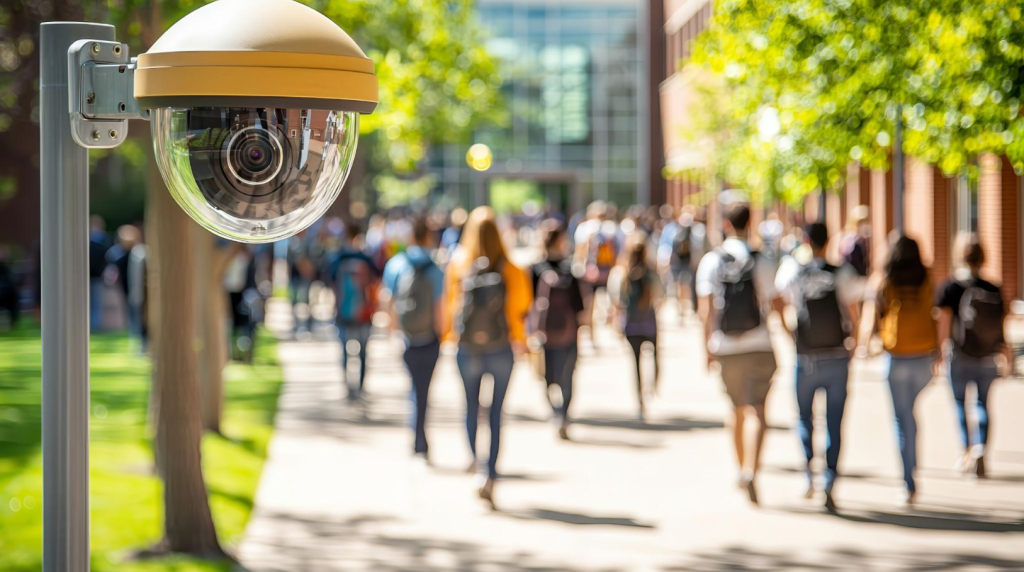
According to the National Center for Education Statistics, 93% of public schools currently use security cameras to monitor their campus. However, even with an ability to watch most, if not all of a campus at once, human error can’t catch everything. One person can only effectively analyze a couple of screens at a time, leaving the possibility for large areas of a campus to go unnoticed and unsupervised.
A shift to A.I. monitoring programs would allow schools to stay closely monitored 24/7, with A.I. programs alerting school authorities within seconds to possible break-ins, weapons, conflicts and medical emergencies on campus.
Using pattern recognition learning software, A.I. programs can learn what normal gatherings and student movement patterns look like. That way when a crowd begins to differ from the normal patterns, indicating a possible emergency situation, school officials can be alerted in real time.
A.I. can also monitor cameras for students or staff who have fallen or collapsed and could possibly be having a medical emergency and need immediate attention.
Maybe the most important use at the moment for A.I. is for weapon recognition. Moments before the Stoneman Douglas High School shooting in 2018 which left 17 dead, former student Nikolas Cruz walked into a building holding a rifle case and making no attempt to conceal it. With A.I. systems monitoring the cameras, the hope is that individuals like Cruz would be flagged the moment they step on campus and stopped by security before they have a chance to turn the weapon on students, staff or themselves.
While A.I. has the capability to be a useful tool in campus security with the possibility to save lives, it’s in no way the perfect or final solution. While A.I. would be able to lock down a building and alert security to a weapon on campus, it can’t prevent weapons from making their way into the hands of young children.
A.I. could also be the cause of future school shootings. A large part of school safety concerns and shootings in the past has been because of mental health issues. There have already been cases of A.I. programs like ChatGPT encouraging suicidal thoughts or helping users plan their own suicides. Chatbots have also helped users plan attacks on religious sites and political opponents, one even going so far as to tell a user “Happy (and safe) shooting!”
“AI chatbots, now embedded into our daily lives, could be helping the next school shooter plan their attack or a political extremist coordinate an assassination,” Imran Ahmed, the chief executive of Center for Countering Digital Hate, said. “When you build a system designed to comply, maximise engagement, and never say no, it will eventually comply with the wrong people. What we’re seeing is not just a failure of technology, but a failure of responsibility.”
The only sure way to protect students, teachers and administrators from violence and attacks at school is to restrict the laws around who can access weapons with the capability to cause mass destruction.
Pressure from citizens to their Congresspeople and representatives to put forward and vote for bills restricting who can access and purchase weapons and where they can be kept when not in use are vital in the fight to end gun violence in schools. Increased monitoring and testing of A.I. systems to ensure they aren’t encouraging suicide or violent attack plans is also essential to student’s mental health and physical safety.
Before you vote in the upcoming November elections, look at each of the candidate’s stances of gun rights and restrictions and their views on A.I. use in both public and private spaces.

