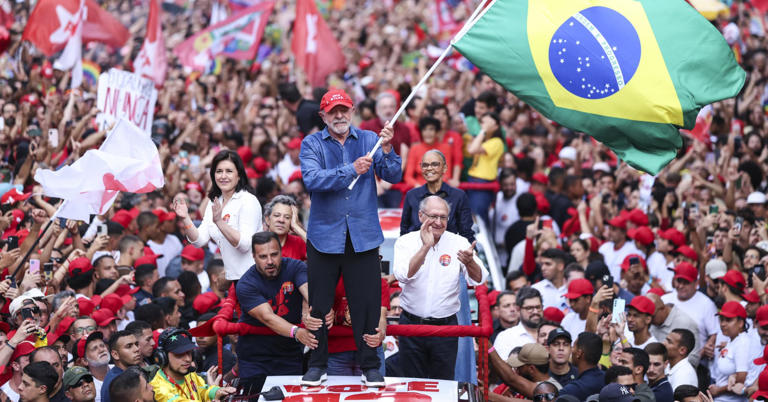
Brazil’s incumbent president Luiz Inácio Lula da Silva defeated far-right Trump ally Sen. Flávio Bolsonaro in a presidential runoff election Oct. 25.
Brazil’s electoral court announced 80-year-old Lula won Sunday evening with 51.8% of the vote, beating Bolsonaro by almost 4.4 million votes. Bolsonaro announced he had refused to accept the defeat after he and Lula made an unprecedented request earlier that evening to extend voting by two hours.
Lula’s political career has spanned nearly six decades, beginning as a union leader in the 1970s. He founded the Worker’s Party and was elected president in 2002. After being reelected in 2006, he was followed by his cabinet minister Dilma Rousseff in 2010. Rousseff was impeached in 2016 due to a corruption scandal. Lula was arrested in 2018 following the same scandal, although he was released after 580 days in prison after the Brazilian Supreme Court annulled his sentence. He was later reelected president in 2022.
Lula’s campaign focused on appealing to younger voters, promising reforms directed at improving the lives of poor and working class citizens.
Lula’s election breaks a trend of far-right leaders being elected to office in South America. Mexican president Claudia Sheinbaum is considered one of the most popular democratically elected leaders in the world, with an approval rating of 70% or more.
Brazil and Mexico are the two most populous countries in Latin America, with a combined GDP of $2.6 trillion per year, allowing the countries to remain independent of the U.S. despite increasing tariffs imposed by U.S. President Donald Trump.
Although Bolsonaro has contested the election results and is requested to have the election results annulled, if the Brazilian electoral court confirms Lula, his new term will begin Jan. 5, 2027.

